Congenital anterolateral tibial bowing associated with polydactyly: case report and literature review
Abstract
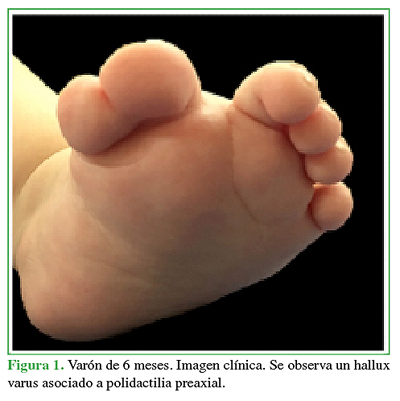
The congenital anterolateral tibial bowing associated with polydactyly (CABTP) is an extremely rare deformity. To the best of our knowledge, only 21 cases have been documented in the English literature. Although there is a strong relationship between anterolateral bowing of the tibia, congenital pseudoarthrosis of the tibia (CPT), and neurofibromatosis type 1 (NF1), CATBP is a specific entity associated with a more favorable prognosis. We report a new CABTP case and our literature review on the previously reported cases of CABTP concerning its associated deformities, diagnosis, and treatment. Key words: Tibial bowing; polydactyly; hallux.Level of Evidence: IVDownloads
References
Hefti F, Bollini G, Dungl P, Fixsen J, Grill F, Ippolito E, et al. Congenital pseudarthrosis of the tibia: history,
etiology, classification, and epidemiologic data. J Pediatr Orthop Br 2000;9(1):11-5.
https://doi.org/10.1097/01202412-200001000-00003
Crawford DA, Tompkins BJ, Baird GO, Caskey PM. The long-term function of the knee in patients with fibular
hemimelia and anterior cruciate ligament deficiency. J Bone Joint Surg Br 2012;94(3):328-33.
https://doi.org/10.1302/0301-620X.94B3.27997
Shah HH, Doddabasappa SN, Joseph BJ. Congenital posteromedial bowing of the tibia: a retrospective analysis of growth abnormalities in the leg. J Pediatr Orthop Br 2009;18(3):120-8.
https://doi.org/10.1097/BPB.0b013e328329dc86
Currarino G, Herring JA, Johnston CE Jr, Birch JG. An unusual form of congenital anterolateral tibial angulationthe delta tibia. Pediatr Radiol 2003;33(5):346-53. https://doi.org/10.1007/s00247-002-0856-7
Gilbert A, Brockman R. Congenital pseudarthrosis of the tibia. Long-term follow-up of 29 cases treated by
microvascular bone transfer. Clin Orthop Relat Res 1995;314:37-44. PMID: 7634649
Newell RL, Durbin FC. The aetiology of congenital angulation of tubular bones with constriction of the medullary canal, and its relationship to congenital pseudarthrosis. J Bone Joint Surg Br 1976;58:444-7. PMID: 1018030
Adamsbaum C, Kalifa G, Seringe R, Bonnet JC. Minor tibial duplication: a new cause of congenital bowing of the
tibia. Pediatr Radiol 1991;21(3):185-8. https://doi.org/10.1007/BF02011043
Weaver KM, Henry GW, Reinker KA. Unilateral duplication of the great toe with anterolateral tibial bowing. J
Pediatr Orthop 1996;16:73-7. https://doi.org/10.1097/00004694-199601000-00015
Kitoh H, Nogami H, Hattori T. Congenital anterolateral bowing of the tibia with ipsilateral polydactyly of the great toe. Am J Med Genet 1997;73:404-7. PMID: 9415465
Bressers MM, Castelein RM. Anterolateral tibial bowing and duplication of the hallux: a rare but distinct entity with good prognosis. J Pediatr Orthop Br 2001;10(2):153-7. PMID: 11360782
Manner HM, Radler C, Ganger R, Grossbotzl G, Petje G, Grill F. Pathomorphology and treatment of congenital
anterolateral bowing of the tibia associated with duplication of the hallux. J Bone Joint Surg Br 2005;87:226-30.
https://doi.org/10.1302/0301-620x.87b2.15132
Lemire EG. Congenital anterolateral tibial bowing and polydactyly: a case report. J Med Case Rep 2007;1:54.
https://doi.org/10.1186/1752-1947-1-54
Breckpot J, Thienpont B, Vanhole C, Van Rossem E, Van Schoubroeck D, Fryns JP, et al. Congenital anterolateral bowing of the tibia with ipsilateral polydactyly of the hallux associated with cerebral cyst: A new entity? Clin Dysmorphol 2009;18:195-200. https://doi.org/10.1097/MCD.0b013e32832d06d7
Han J, Qu L, Li Y, Luo J, Cao J, Zhao W. A benign form of congenital anterolateral bowing of the tibia associated
with ipsilateral polydactyly of the hallux: case report and literature review. Am J Med Genet Am 2012;158(7):1742-
https://doi.org/10.1002/ajmg.a.35417
Beck JJ, Altiok H. Congenital tibial dysplasia with lateral bowing and duplication of hallux: case presentations. J
Pediatr Orthop B 2013;22(3):213-8. https://doi.org/10.1097/BPB.0b013e328352ad09
Jahmani R, Alorjani M. Anterolateral bowing of congenital pseudoarthrosis of tibia treated by percutaneous
osteotomy and gradual correction using Taylor spatial frame, then late insertion of a Fussier-Duval nail: a case
report. Am J Case Rep 2018;19:426-30. https://doi.org/10.12659/ajcr.908482
Manuscript acceptance by the Journal implies the simultaneous non-submission to any other journal or publishing house. The RAAOT is under the Licencia Creative Commnos Atribución-NoComercial-Compartir Obras Derivadas Igual 4.0 Internacional (CC-BY-NC.SA 4.0) (http://creativecommons.org/licences/by-nc-sa/4.0/deed.es). Articles can be shared, copied, distributed, modified, altered, transformed into a derivative work, executed and publicly communicated, provided a) the authors and the original publication (Journal, Publisher and URL) are mentioned, b) they are not used for commercial purposes, c) the same terms of the license are maintained.
In the event that the manuscript is approved for its next publication, the authors retain the copyright and will assign to the journal the rights of publication, edition, reproduction, distribution, exhibition and communication at a national and international level in the different databases. data, repositories and portals.
It is hereby stated that the mentioned manuscript has not been published and that it is not being printed in any other national or foreign journal.
The authors hereby accept the necessary modifications, suggested by the reviewers, in order to adapt the manuscript to the style and publication rules of this Journal.