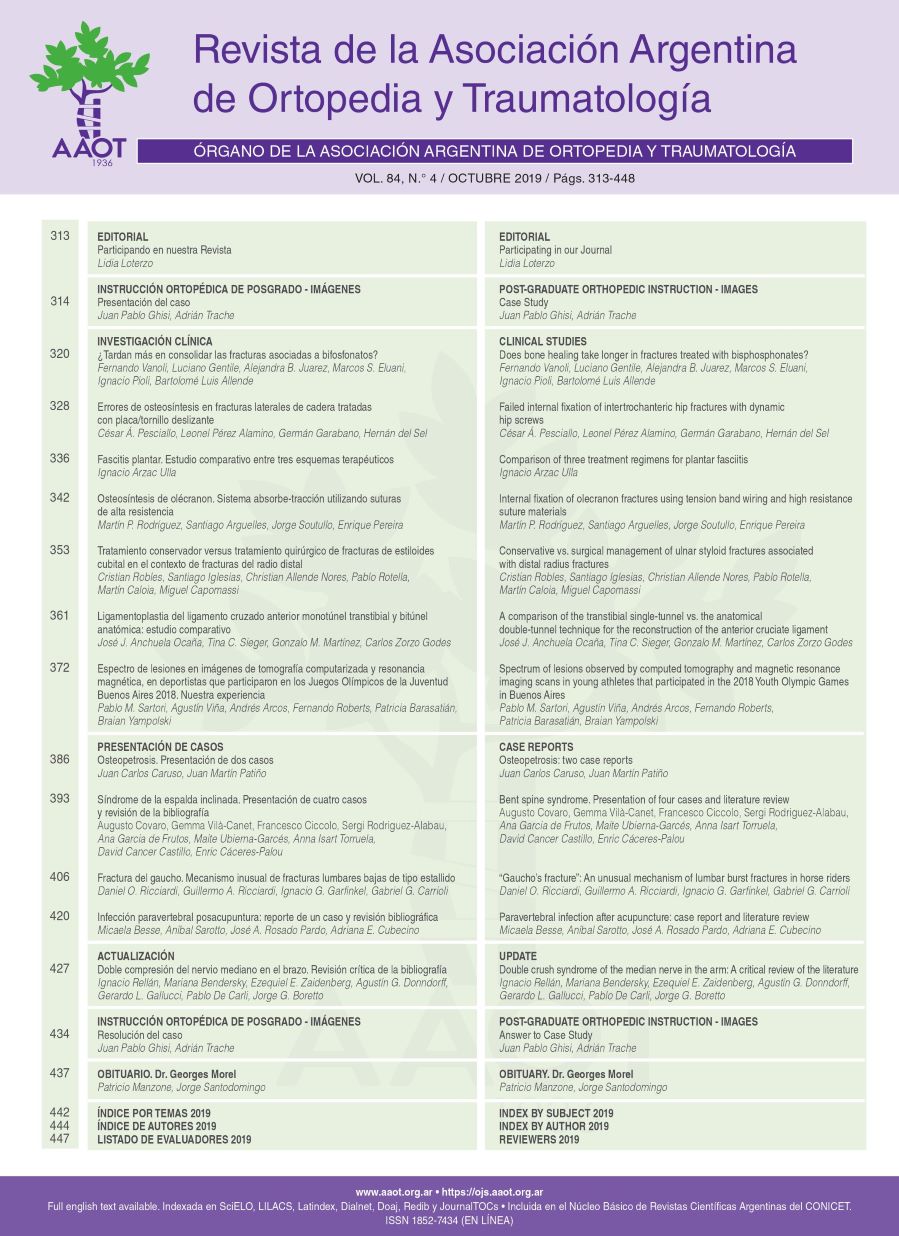
Is the time for consolidation of fractures associated with bisphosphonates higher?
Abstract
Introduction: Bisphosphonates evolved as the mainstay for the treatment of osteoporosis, reducing the incidence of fractures. Recently, several publications described the occurrence of low-energy atypical femur fractures associated with the use of bisphosphonates. The objective of this work was to study the average time of consolidation of the atypical femoral fractures caused by the consumption of bisphosphonates compared with a control group.Materials and Methods: We retrospectively evaluated 34 patients with atypical femoral fractures of which 16 patients had undergone treatment with bisphosphonates for at least 5 years, treated between 2006 and 2017, and stabilized with a cephalomedullary nail, and were compared with a control group of similar characteristics.Results: All the patients were female. The average age was 74 years. 22 presented subtrochanteric fractures while 12 were diaphyseal. 14% of the subjects who took bisphosphonates and received surgical treatment, required a revision versus 5.5% of the control group. The average time of consolidation was higher in those treated with bisphosphonates (8.5 months vs. 6 months), this being statistically significant (p <0.001).Conclusions: The benefit of treatment with bisphosphonates in the prevention of fractures is greater than the risk of atypical fractures. However, it is important to evaluate the risk-benefit in each patient at the beginning and the duration of the treatment, taking into account that despite this, the healing time is longer.Downloads
References
Chrischilles EA, Dasbach EJ, Rubenstein LM, Cook JR, Tabor HK, Black DM; for the Fracture Intervention Trial Research Group. The effect of alendronate on fracture-related healthcare utilization and costs: The Fracture Intervention Trial. Osteoporos Int 2001;12:654-60. https://doi.org/10.1007/s001980170065
Harris ST, Watts NB, Genant HK, McKeever CD, Hangartner T, Keller M, et al. Effects of risedronate treatment on vertebral and nonvertebral fractures in women with postmenopausal osteoporosis: a randomized controlled trial. Vertebral Efficacy With Risedronate Therapy (VERT) Study Group. JAMA 1999;282:1344-52. https://doi.org/10.1001/jama.282.14.1344
Hosking D, Chilvers CE, Christiansen C, Ravn P, Wasnich R, Ross P, et al. Prevention of bone loss with alendronate in postmenopausal women under 60 years of age. Early Postmenopausal Intervention Cohort Study Group. N Engl J Med 1998;338:485-92. https://doi.org/10.1056/NEJM199802193380801
Karpf DB, Shapiro DR, Seeman E, Ensrud KE, Johnston CC Jr, Adami S, et al. Prevention of nonvertebral fractures by alendronate: a meta-analysis. Alendronate Osteoporosis Treatment Study Groups. JAMA 1997;277:1159-64. https://doi.org/10.1001/jama.1997.03540380073035
Liberman UA, Weiss SR, Broll J, Minne HW, Quan H, Bell NH, et al. Effect of oral alendronate on bone mineral density and the incidence of fractures in postmenopausal osteoporosis. The Alendronate Phase III Osteoporosis Treatment Study Group. N Engl J Med 1995;333:1437-43. https://doi.org/10.1056/NEJM199511303332201
Riggs BL, Melton LJ III. The prevention and treatment of osteoporosis. N Engl J Med 1992;327:620-7. https://doi.org/10.1056/NEJM199208273270908
Wells GA, Cranney A, Peterson J, Boucher M, Shea B, Robinson V, et al. Alendronate for the primary and secondary prevention of osteoporotic fractures in postmenopausal women. Cochrane Database Syst Rev 2008;CD001155. . https://doi.org/10.1002/14651858.CD001155.pub2
Cao Y, Mori S, Mashiba T, Westmore MS, Ma L, Sato M, et al. Raloxifene, estrogen, and alendronate affect the processes of fracture repair differently in ovariectomized rats. J Bone Miner Res 2002;17:2237-46. https://doi.org/10.1359/jbmr.2002.17.12.2237
Isaacs JD, Shidiak L, Harris IA, Szomor ZL. Femoral insufficiency fractures associated with prolonged bisphosphonate therapy. Clin Orthop Relat Res 2010;468:3384-92. https://doi.org/10.1007/s11999-010-1535-x
Mashiba T, Hui S, Turner CH, Mori S, Johnston CC, Burr DB. Bone remodeling at the iliac crest can predict the changes in remodeling dynamics, microdamage accumulation, and mechanical properties in the lumbar vertebrae of dogs. Calcif Tissue Int 2005;77:180-5. https://doi.org/10.1007/s00223-005-1295-x
Mashiba T, Mori S, Burr DB, Komatsubara S, Cao Y, Manabe T, Norimatsu H. The effects of suppressed bone remodeling by bisphosphonates on microdamage accumulation and degree of mineralization in the cortical bone of dog rib. J Bone Miner Metab 2005;23(Suppl):36-42. https://doi.org/10.1007/BF03026321
Fisher JE, Rogers MJ, Halasy JM, Luckman SP, Hughes DE, Masarachia PJ, et al. Alendronate mechanism of action: geranylgeraniol, an intermediate in the mevalonate pathway, prevents inhibition of osteoclast formation, bone resorption, and kinase activation in vitro. Proc Natl Acad Sci 1999;96:133-8. https://doi.org/10.1073/pnas.96.1.133
Luckman SP, Hughes DE, Coxon FP, Graham R, Russell G, Rogers MJ. Nitrogen-containing bisphosphonates inhibit the mevalonate pathway and prevent post-translational prenylation of GTP-binding proteins, including Ras. J Bone Miner Res 1998;13:581-9. https://doi.org/10.1359/jbmr.1998.13.4.581
Odvina CV, Zerwekh JE, Rao DS, Maalouf N, Gottschalk FA, Pak CY. Severely suppressed bone turnover: a potential complication of alendronate therapy. J Clin Endocrinol Metab 2005;90:1294-1301. https://doi.org/10.1210/jc.2004-0952
Ahn JK, Lee J, Cha HS, Koh EM. Non-traumatic fracture of the femoral shaft in a patient taking long-term bisphosphonate therapy. Rheumatol Int 2011;31:973-5. https://doi.org/10.1007/s00296-010-1477-3
Aspenberg P. Bisphosphonate-induced fractures: nature strikes back? Acta Orthop 2008;79:459-60. https://doi.org/10.1080/17453670710015427
Goh S-K, Yang KY, Koh JS, Wong MK, Chua SY, Chua DT, Howe TS. Subtrochanteric insufficiency fractures in patients on alendronate therapy: a caution. J Bone Joint Surg Br 2007;89:349-53. https://doi.org/10.1302/0301-620X.89B3.18146
Chan SS, Rosenberg ZS, Chan K, Capeci C. Subtrochanteric femoral fractures in patients receiving long-term alendronate therapy: imaging features. AJR Am J Roentgenol 2010;194(6):1581-6. https://doi.org/10.2214/AJR.09.3588
Weil YA, Rivkin G, Safran O, Liebergall M, Foldes AJ. The outcome of surgically treated femur fractures associated with long-term bisphosphonate use. J Trauma 2011;71(1):186-90. https://doi.org/10.1097/TA.0b013e31821957e3
Egol KA, Park JH, Rosenberg ZS, Peck V, Tejwani NC. Healing delayed but generally reliable after bisphosphonate-associated complete femur fractures treated with IM nails. Clin Orthop Relat Res 2014;472(9):2728-34. https://doi.org/10.1007/s11999-013-2963-1
Prasarn ML, Ahn J, Helfet DL, Lane JM, Lorich DG. Bisphosphonate-associated femur fractures have high complication rates with operative fixation. Clin Orthop Relat Res 2012;470(8):2295-301. https://doi.org/10.1007/s11999-012-2412-6
Kang JS, Won YY, Kim JO, Min BW, Lee KH, Park KK, et al. Atypical femoral fractures after anti-osteoporotic medication: a Korean multicenter study. Int Orthop 2014;38(6):1247-53. https://doi.org/10.1007/s00264-013-2259-9
Grady MK, Watson JT, Cannada LK. Treatment of femoral fracture nonunion after long-term bisphosphonate use. Orthopedics 2012;35(6):e991-5. https://doi.org/10.3928/01477447-20120525-51
Sasaki S, Miyakoshi N, Hongo M, Kasukawa Y, Shimada Y. Low-energy diaphyseal femoral fractures associated with bisphosphonate use and severe curved femur: a case series. J Bone Miner Metab 2012;30(5):561-7. https://doi.org/10.1007/s00774-012-0358-0
Shane E, Burr D, Abrahamsen B, Adler RA, Brown TD, Cheung AM, et al. Atypical subtrochanteric and diaphyseal femoral fractures: second report of a task force of the American Society for Bone and Mineral Research. J Bone Miner Res 2014;29(1):1-23. https://doi.org/10.1002/jbmr.1998
Whelan DB, Bhandari M, McKee MD, Guyatt GH, Kreder HJ, Stephen D, et al. Interobserver and intraobserver variation in the assessment of the healing of tibial fractures after intramedullary fixation. J Bone Joint Surg Br 2002;84(1):15-8. https://doi.org/10.1302/0301-620x.84b1.11347
Morris C, Einhorn T. Bisphosphonates in Orthopaedic Surgery. J Bone Joint Surg Am 2005;87:1609-618. https://doi.org/10.2106/JBJS.D.03032
Gehrig L, Lane J, O’Connor M. Osteoporosis: management and treatment strategies for orthopaedic surgeons. J Bone Joint Surg Am 2008;90(6):1362-74. PMID: 18519332
Lyles K, Colón-Emeric C, Magaziner J, Adachi J, Pieper C. Zoledronic acid and clinical fractures and mortality after hip fracture. N Engl J Med 2007; 357:1799-809. https://doi.org/10.1056/NEJMoa074941
Capeci C, Tejwani N. Bilateral low-energy simultaneous or sequential femoral fractures in patients on long-term Alendronate therapy. J Bone Joint Surg Am 2009;91:2556-61. https://doi.org/10.2106/JBJS.H.01774
Puhaindran M, Farooki A, Steensma M, Hameed M, Healey J, Boland P. Atypical sub-trochanteric femoral fractures in patients with skeletal malignant involvement treated with intravenous bisphosphonates. J Bone Joint Surg Am 2011;93:1235-42. https://doi.org/10.2106/JBJS.J.01199
Rio M, Salonia P, Gabas D, Gotter G, Barrera Oro F. Fracturas de fémur asociadas al consumo prolongado de alendronato. Informe de dos casos. Rev Asoc Argent Ortop Traumatol 2011;76:74-76. http://www.scielo.org.ar/pdf/raaot/v76n1/v76n1a12.pdf
Fowler J, Criner K, Craig M. Prophylactic intramedullary fixation for bisphosphonate-related subtrochanteric stress fracture. Orthopedics 2012;35(6):e954-7. https://doi.org/10.3928/01477447-20120525-41
Yoon R, Beebe K, Benevenia J. Prophylactic bilateral intramedullary femoral nails for bisphosphonate-associated signs of impending subtrochanteric hip fracture. Orthopedics 2010;33(4). https://doi.org/10.3928/01477447-20100225-21
Banffy M, Vrahas M, Ready J, Abraham J. Nonoperative versus prophylactic treatment of bisphosphonate-associated femoral stress fractures. Clin Orthop Relat Res 2011;469(7):2028-34. https://doi.org/10.1007/s11999-011-1828-8
Thompson RN, Phillips JR, McCauley SH, Elliott JR, Moran CG. Atypical femoral fractures and bisphosphonate treatment: experience in two large United Kingdom teaching hospitals. J Bone Joint Surg Br 2012;94(3):385-90. https://doi.org/10.1302/0301-620X.94B3.27999
Unnanuntana A, Saleh A, Mensah KA, Kleimeyer JP, Lane JM. Atypical femoral fractures: what do we know about them? AAOS Exhibit Selection. J Bone Joint Surg Am 2013;95:e8(1-13). https://doi.org/10.2106/JBJS.L.00568
Issack PS. Bisphosphonate-associated subtrochanteric femoral fracture with profound proximal cortical thickening and canal narrowing requiring blade-plate fixation. A report of two cases. J Bone Joint Surg Case Connect 2014;24:e87. https://doi.org/10.2106/JBJS.CC.N.00026
Shane E, Burr D, Ebling PR, Abrahamsen B, Adler RA, Brown TD, et al. Atypical subtrochanteric and diaphyseal femoral fractures: report of a task force of the American Society for Bone and Mineral Research. J Bone Miner Res 2010;25:2267-94. https://doi.org/10.1002/jbmr.253
Copyright (c) 2019 Revista de la Asociación Argentina de Ortopedia y Traumatología

This work is licensed under a Creative Commons Attribution-NonCommercial-ShareAlike 4.0 International License.
Manuscript acceptance by the Journal implies the simultaneous non-submission to any other journal or publishing house. The RAAOT is under the Licencia Creative Commnos Atribución-NoComercial-Compartir Obras Derivadas Igual 4.0 Internacional (CC-BY-NC.SA 4.0) (http://creativecommons.org/licences/by-nc-sa/4.0/deed.es). Articles can be shared, copied, distributed, modified, altered, transformed into a derivative work, executed and publicly communicated, provided a) the authors and the original publication (Journal, Publisher and URL) are mentioned, b) they are not used for commercial purposes, c) the same terms of the license are maintained.
In the event that the manuscript is approved for its next publication, the authors retain the copyright and will assign to the journal the rights of publication, edition, reproduction, distribution, exhibition and communication at a national and international level in the different databases. data, repositories and portals.
It is hereby stated that the mentioned manuscript has not been published and that it is not being printed in any other national or foreign journal.
The authors hereby accept the necessary modifications, suggested by the reviewers, in order to adapt the manuscript to the style and publication rules of this Journal.