Variation among Argentinean orthopedic surgeons in the therapeutic indications for rotator cuff tears
Abstract
Introduction: Indications in the operative and nonoperative treatment of rotator cuff tears are widely discussed and not standardized. The aim of this study is to evaluate the variability among Argentinean orthopedic surgeons regarding the indications of treatment for different rotator cuff injuries. Materials and Methods: A questionnaire was developed based on the study carried out by Dunn et al. Our aim was to gather the opinions of Argentinean orthopedic surgeons on decision-making concerning thetreatment of different rotator cuff lesions. The questionnaire was sent to 2 groups: general orthopedic surgeons and shoulder specialist surgeons, included according to the number of shoulders treated surgically and non-surgically in 2017. The questionnaire has two sections: 4 hypothetical clinical cases and 11 questions on factors that could influence treatment selection. Results: Out of 556 questionnaires sent, 162 were completed, 117 by general orthopedic surgeons and 45 by shoulder specialists. The specialists reported mostly arthroscopic repairs (60%), general orthopedic surgeons reported repairing these injuries mainly by mini-open or by standard open technique (49% and 22% respectively). The failure rate was considered to be 20%, not evidencing differences between professionals (P=0.42). There was also agreement in the contraindication of the use of corticosteroids before surgery(P=0.74). Conclusion: This study evidences significant variability in the management of these patients (for which we selected potentially controversial injuries), making it difficult to establish protocols or consensus guidelines to help standardize treatments for these injuries. Level of evidence: IIbDownloads
References
Dunn WR, Schackman BR, Walsh C, Lyman S, Jones EC, Warren RF, et al. Variation in orthopaedic surgeons’
perceptions about the indications for rotator cuff surgery. J Bone Joint Surg Am 2005;87:1978-84.
https://doi.org/10.2106/JBJS.D.02944
Tashjian RZ. Epidemiology, natural history, and indications for treatment of rotator cuff tears. Clin Sports Med
;31:589-604. https://doi.org/10.1016/j.csm.2012.07.001
Elia F, Azoulay V, Lebon J, Farau A, Bonnevialle N, Mansat P. Clinical and anatomic results of surgical repair of
chronic rotator cuff tears at ten-year minimum follow-up. Int Orthop 2017;41(6):1219-26. https://doi.org/10.1007/s00264-017-3456-8
Neri BR, Chan KW, Kwon YW. Management of massive and irreparable rotator cuff tears. J Shoulder Elbow
Surg 2009;18(5):808-18. https://doi.org/10.1016/j.jse.2009.03.013
Bedi A, Dines J, Warren RF, Dines DM. Massive tears of the rotator cuff. J Bone Joint Surg Am 2010;92(9):1894-
https://doi.org/10.2106/JBJS.I.01531
Gerber C, Fuchs B, Hodler J. The results of repair of massive tears of the rotator cuff. J Bone Joint Surg
Am 2000;82(4):505-15. https://doi.org/10.2106/00004623-200004000-00006
Galatz LM, Rothermich SY, Zaegel M, Silva MJ, Havlioglu N, Thomopoulos S. Delayed repair of tendon to bone
injuries leads to decreased biomechanical properties and bone loss. J Orthop Res 2005;23(6):1441-7.
https://doi.org/10.1016/j.orthres.2005.05.005.1100230629
Dodson CC, Kitay A, Verma NN, Adler RS, Nguyen J, Cordasco FA, et al. The long-term outcome of recurrent
defects after rotator cuff repair. Am J Sports Med 2010;38(1):35-9. https://doi.org/10.1177/0363546509341654
Papadopoulos P, Karataglis D, Boutsiadis A, Fotiadou A, Christoforidis J, Christodoulou A. Functional outcome and structural integrity following mini-open repair of large and massive rotator cuff tears: a 3-5 year follow-up study. J Shoulder Elbow Surg 2011;20(1):131-7. https://doi.org/10.1016/j.jse.2010.05.026
Zumstein MA, Jost B, Hempel J, Hodler J, Gerber C. The clinical and structural long-term results of open repair of massive tears of the rotator cuff. J Bone Joint Surg Am 2008;90(11):2423-31. https://doi.org/10.2106/JBJS.G.00677
Williams GR Jr, Rockwood CA Jr, Bigliani LU, Iannotti JP, Stanwood W. Rotator cuff tears: why do we repair
them? J Bone Joint Surg Am 2004;86(12):2764-76. PMID: 15590865
Galatz LM, Ball CM, Teefey SA, Middleton WD, Yamaguchi K. The outcome and repair integrity of completely
arthroscopically repaired large and massive rotator cuff tears. J Bone Joint Surg Am 2004;86(2):219-24. https://doi.org/10.2106/00004623-200402000-00002
Cordasco FA, Bigliani LU. The rotator cuff. Large and massive tears. Technique of open repair. Orthop Clin North Am 1997;28(2):179-93. https://doi.org/10.1016/s0030-5898(05)70278-9
Lam F, Mok D. Open repair of massive rotator cuff tears in patients aged sixty-five years or over: is it worthwhile? J Shoulder Elbow Surg 2004;13(5):517-21. https://doi.org/10.1016/j.jse.2004.02.016
Cofield RH, Parvizi J, Hoffmeyer PJ, Lanzer WL, Ilstrup DM, Rowland CM. Surgical repair of chronic rotator cuff
tears. A prospective long-term study. J Bone Joint Surg Am 2001;83(1):71-7.
https://doi.org/10.2106/00004623-200101000-00010
Kukkonen J, Joukainen A, Lehtinen J, Mattila KT, Tuominen EK, Kauko T, et al. Treatment of non-traumatic rotator cuff tears: a randomised controlled trial with one-year clinical results. Bone Joint J Br 2014;96:75-81. https://doi.org/10.1302/0301-620X.96B1.32168
Moosmayer S, Lund G, Seljom U, Svege I, Hennig T, Tariq R, et al. Comparison between surgery and physiotherapy in the treatment of small and medium-sized tears of the rotator cuff: a randomized controlled study of 103 patients with one-year follow-up. J Bone Joint Surg Br 2010;92:83-91.
https://doi.org/10.1302/0301-620X.92B1.22609
Mohamadi A, Chan J, Claessen F, Ring D. Corticosteroid injections give small and transient pain relief in rotator cuff tendinosis: A meta-analysis. Clin Orthop Relat Res 2017; 475:232-43.
https://doi.org/10.1007/s11999-016-5002-1
Chung SW, Oh JH, Gong HS, Kim JY, Kim SH. Factors affecting rotator cuff healing after arthroscopic repair. Osteoporosis as one of the independent risk factors. Am J Sports Med 2011;39:2099-107. https://doi.org/10.1177/0363546511415659
Lapner PC, Su Y, Simon D, El-Fatori S, Lopez-Vidriero E. Does the upward migration index predict function and
quality of life in arthroscopic rotator cuff repair? Clin Orthop Relat Res 2010;468:3063-9.
https://doi.org/10.1007/s11999-010-1457-7
Warrender WJ, Brown OL, Abboud JA. Outcomes of arthroscopic rotator cuff repairs in obese patients. J Shoulder Elbow Surg 2011;20:961-7. https://doi.org/10.1016/j.jse.2010.11.006
Wessel RN, Rasenberg EIJ, Guldemond NA, Lim TE. Arthroscopisch rotator cuff repair nader geanalyseerd. Een
prospectieve studie bij 70 patienten met een rotator cufflaesie. Ned Tijdschrift Orthop 2007;14:137-42.
Manaka T, Ito Y, Matsumoto I, Takaoka K, Nakamura H. Functional recovery period after arthroscopic rotator cuff repair: is it predictable before surgery? Clin Orthop Relat Res 2011;469:1660-6. https://doi.org/10.1007/s11999-010-1689-6
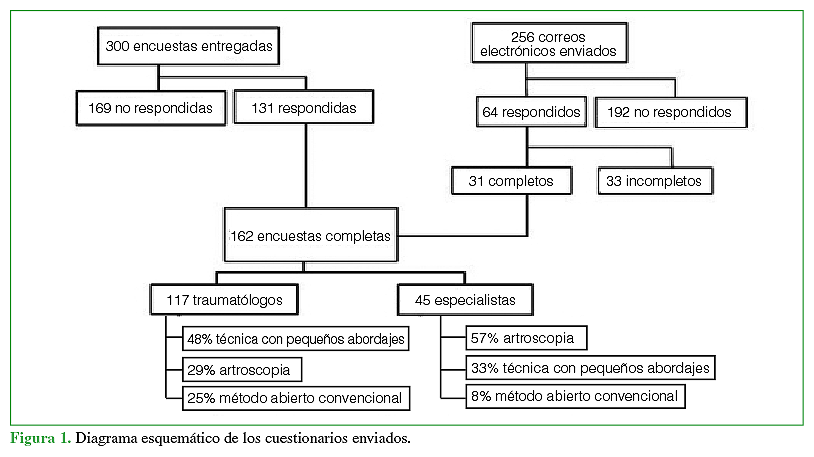
- Figura 1 (Español (España))
- Figura 2 (Español (España))
- Figura 3 (Español (España))
- Figura 4 (Español (España))
- Figura 5 (Español (España))
- Tabla 1 (Español (España))
- Tabla 2 (Español (España))
- Tabla 3 (Español (España))
- Tabla 4 (Español (España))
- Anexo 1 (Español (España))
- Anexo 2 (Español (España))
Manuscript acceptance by the Journal implies the simultaneous non-submission to any other journal or publishing house. The RAAOT is under the Licencia Creative Commnos Atribución-NoComercial-Compartir Obras Derivadas Igual 4.0 Internacional (CC-BY-NC.SA 4.0) (http://creativecommons.org/licences/by-nc-sa/4.0/deed.es). Articles can be shared, copied, distributed, modified, altered, transformed into a derivative work, executed and publicly communicated, provided a) the authors and the original publication (Journal, Publisher and URL) are mentioned, b) they are not used for commercial purposes, c) the same terms of the license are maintained.
In the event that the manuscript is approved for its next publication, the authors retain the copyright and will assign to the journal the rights of publication, edition, reproduction, distribution, exhibition and communication at a national and international level in the different databases. data, repositories and portals.
It is hereby stated that the mentioned manuscript has not been published and that it is not being printed in any other national or foreign journal.
The authors hereby accept the necessary modifications, suggested by the reviewers, in order to adapt the manuscript to the style and publication rules of this Journal.