Versatility of the Tibia Long Retrograde Intramedullary Nail for Tibiotalocalcaneal Arthrodesis in Patients with Associated Lesions in the Same Segment
Abstract
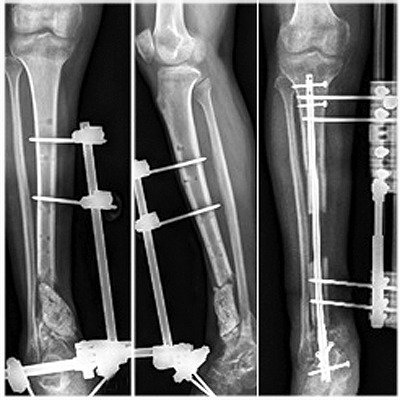
Background: The joint condition that leads to the need for a tibiocalcaneal arthrodesis may be accompanied by a second injury in the same bone segment, and design nails for arthrodesis are not of adequate length to cover both injuries. We have not found therapeutic options for this type of injury in the literature. Objective: To present a series of cases where a single tibia nail (antegrade placement) was used retrogradely, with the dual objective of performing a tibiotalocalcaneal arthrodesis added to the treatment of an associated injury in the same surgical stage. Materials and methods: We retrospectively evaluated a group of 12 patients who required a tibiotalocalcaneal arthrodesis as well as to simultaneously resolve a local secondary defect from September2009 to June 2019. The average age was 43.7 (27-61) years, and the global follow-up was 43.9 months. Results: All patients achieved a tibiocalcaneal arthrodesis confirmed in antero-posterior and lateral radiographs, and 83.3% of the patients recovered their bone stock completely. Conclusion: Faced with the lack of osteosynthesis in the market to resolve associated pathologies in the same patient, we propose the use of a long tibial intramedullary nail placed in a retrograde manner as a treatment option since it has proven to be efficient in achieving tibiocalcaneal arthrodesis. In addition, it could be used as a rail for bone lengthening and transport, and as stabilization to treat simultaneous injuries.Downloads
References
Caixeta TB, Oliveira Calabria C Jr, de Castro RV, Martins JS, Costa EN, Albieri AD, et al. Tibiotalocalcaneal
arthrodesis with retrograde intramedullary nailing: 29 patients clinical and functional evaluation. Rev Bras Ortop
;49(1):56-61. https://doi.org/10.1016/j.rbo.2013.11.002
Hsu AR, Ellington JK, Adams SB. Tibiotalocalcaneal arthrodesis using a nitinol intramedullary hindfoot nail. Foot
Ankle Spec 2015;8(5):389-96. https://doi.org/10.1177/1938640015598838
Francesch F, Franceschetti E, Torre G, Papalia R, Samuelsson K, Karlsson J, et al. Tibiotalocalcaneal arthrodesis
using an intramedullary nail: a systematic review. Knee Surg Sports Traumatol Arthrosc 2016;24(4):1316-25.
https://doi.org/10.1111/os.12171
Aggerwal S, Soni A, Saini UC, Gahlot N. Removal of a bent tibial intramedullary nail: a rare case report and review of the literature. Chin J Traumatol 2011;14(2):107-10. https://doi.org/10.3760/cma.j.issn.1008 1275.2011.02.009
Thordarson DB, Chang D. Stress fractures and tibial cortical hypertrophy after tibiotalocalcaneal arthrodesis with an intramedullary nail. Foot Ankle Int 1999;20(8):497-500. https://doi.org/10.1177/107110079902000806
Noonan T, Pinzur M, Paxinos O, Havey R, Patwardhin A. Tibiotalocalcaneal arthrodesis with a retrograde
intramedullary nail: a biomechanical analysis of the effect of nail length. Foot Ankle Int 2005;26(4):304-8.
https://doi.org/10.1177/107110070502600406
Pinzur MS, Noonan T. Ankle arthrodesis with a retrograde femoral nail for Charcot ankle arthropathy. Foot Ankle Int 2005;26(7):545-9. https://doi.org/10.1177/107110070502600709
Baker G, Mayne AIW, Andrews C. Fixation of unstable ankle fractures using a long hindfoot nail. Injury
;49(11):2083-6. https://doi.org/10.1016/j.injury.2018.07.028
Burns PR, Dunse A. Tibiotalocalcaneal arthrodesis for foot and ankle deformities. Clin Podiatr Med Surg
;34(3):357-80. https://doi.org/10.1016/j.cpm.2017.02.007
Xu L, Zhou J, Wang Z, Xiong J, Qiu Y,Wang, S. Reconstruction of bone defect with allograft and retrograde
intramedullary nail for distal tibia osteosarcoma. Foot Ankle Surg 2017;24(2):149-53. https://doi.org/10.1016/j.fas.2017.01.006
Manuscript acceptance by the Journal implies the simultaneous non-submission to any other journal or publishing house. The RAAOT is under the Licencia Creative Commnos Atribución-NoComercial-Compartir Obras Derivadas Igual 4.0 Internacional (CC-BY-NC.SA 4.0) (http://creativecommons.org/licences/by-nc-sa/4.0/deed.es). Articles can be shared, copied, distributed, modified, altered, transformed into a derivative work, executed and publicly communicated, provided a) the authors and the original publication (Journal, Publisher and URL) are mentioned, b) they are not used for commercial purposes, c) the same terms of the license are maintained.
In the event that the manuscript is approved for its next publication, the authors retain the copyright and will assign to the journal the rights of publication, edition, reproduction, distribution, exhibition and communication at a national and international level in the different databases. data, repositories and portals.
It is hereby stated that the mentioned manuscript has not been published and that it is not being printed in any other national or foreign journal.
The authors hereby accept the necessary modifications, suggested by the reviewers, in order to adapt the manuscript to the style and publication rules of this Journal.