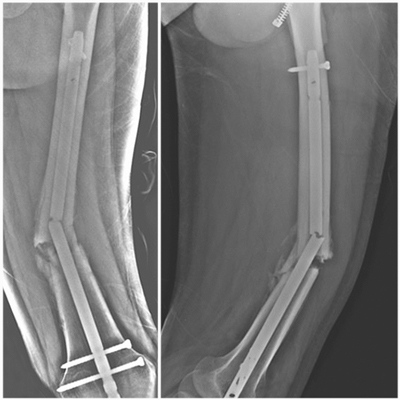
Retrograde Femoral Intramedullary Nail Extraction Techniques. Report of Three Cases
DOI:
https://doi.org/10.15417/issn.1852-7434.2021.86.3.986Keywords:
Broken, nail, retrograde, femur, extractionAbstract
Background: The indication for osteosynthesis with a retrograde intramedullary nail in femur fractures has increased in recent years and with it, the number of complications. Three surgical techniques are described for the management of the proximal fragment of the broken intramedullary osteosynthesis. From March 2001 to January 2019, 321 osteosyntheses with retrograde femoral intramedullary nails were performed at our institution. The implant rupture rate associated with nonunion was 0.9%. Minimally invasive
techniques were performed to remove the implant, preserving the soft tissues. Definitive reosteosynthesis was achieved with the consequent consolidation in an average time of 140 days.
Conclusions: The techniques used were simple, safe, minimally invasive, and reproducible.
Downloads
References
Winquist RA, Hansen ST Jr, Clawson DK. Closed intramedullary nailing of femoral fractures. A report of five
hundred and twenty cases. J Bone Joint Surg Am 1984;66(4):529-39. PMID: 6707031 DOI: https://doi.org/10.2106/00004623-198466040-00006
Pereira S, Lugones A, Vindver GI, Bidolegui FM. Enclavado endomedular retrógrado en fracturas diafisarias de
fémur: indicaciones, técnica y resultados. Rev Asoc Argent Ortop Traumatol 2014;79(4):210-17. https://doi.org/10.15417/340 DOI: https://doi.org/10.15417/340
Sanders R, Koval KJ, DiPasquale T, Helfet DL, Frankle M. Retrograde reamed femoral nailing. J Orthop Trauma
;7(4):293-302. https://doi.org/10.1097/00005131-199308000-00001 DOI: https://doi.org/10.1097/00005131-199308000-00001
Janzing HM, Stockman B, Van Damme G, Rommens P, Broos PL. The retrograde intramedullary nail: prospective experience in patients older than sixty-five years. J Orthop Trauma 1998;12(5):330-3.
https://doi.org/10.1097/00005131-199806000-00006 DOI: https://doi.org/10.1097/00005131-199806000-00006
Benirschke SK, Melder I, Henley MB, Routt ML, Smith DG, Chapman JR, et al. Closed interlocking nailing
of femoral shaft fractures: assessment of technical complications and functional outcomes by comparison of a
prospective database with retrospective review. J Orthop Trauma 1993;7(2):118-22. PMID: 8459295 DOI: https://doi.org/10.1097/00005131-199304000-00003
Tornetta P 3rd, Tiburzi D. The treatment of femoral shaft fractures using intramedullary interlocked nails with and without intramedullary reaming: a preliminary report. J Orthop Trauma 1997;11(2):89-92.
https://doi.org/10.1097/00005131-199702000-00003 DOI: https://doi.org/10.1097/00005131-199702000-00003
Pape HC, Remmers D, Regel G, Tscherne H. Pulmonale Komplikationen nach intramedullärer Stabilisierung langer Röhrenknochen. Einfluss von Operationsverfahren, -Zeitpunkt und Verletzungsmuster [Pulmonary complications following intramedullary stabilization of long bones. Effect of surgical procedure, time and injury pattern]. Orthopade 1995;24(2):164-72. PMID: 7753541
Moed BR, Watson JT. Retrograde intramedullary nailing, without reaming, of fractures of the femoral shaft in
multiply injured patients. J Bone Joint Surg Am 1995;77(10):1520-7. https://doi.org/10.2106/00004623-199510000-00006 DOI: https://doi.org/10.2106/00004623-199510000-00006
Franklin JL, Winquist RA, Benirschke SK, Hansen ST Jr. Broken intramedullary nails. J Bone Joint Surg Am
;70(10):1463-71. PMID: 3198670
Brewster NT, Ashcroft GP, Scotland TR. Extraction of broken intramedullary nails--an improvement in technique. Injury 1995;26(4):286. https://doi.org/10.1016/0020-1383(95)90020-x DOI: https://doi.org/10.1016/0020-1383(95)90020-X
Hak DJ, McElvany M. Removal of broken hardware. J Am Acad Orthop Surg 2008;16(2):113-20.
https://doi.org/10.5435/00124635-200802000-00009 DOI: https://doi.org/10.5435/00124635-200802000-00009
Blake SM. A technique for the removal of the distal part of a broken intramedullary nail. Ann R Coll Surg Engl
;91(2):169-70. https://doi.org/10.1308/rcsann.2009.91.2.169 DOI: https://doi.org/10.1308/rcsann.2009.91.2.169
Magu NK, Sharma AK, Singh R. Extraction of the broken intramedullary femoral nail--an innovative technique.
Injury 2004;35(12):1322-3. https://doi.org/10.1016/S0020-1383(03)00314-0 DOI: https://doi.org/10.1016/S0020-1383(03)00314-0
Karladani AH. Removal of a broken nail using a guide wire and a screw. Acta Orthop 2006;77(6):986-8.
https://doi.org/10.1080/17453670610013330 DOI: https://doi.org/10.1080/17453670610013330
Abdelgawad AA, Kanlic E. Removal of a broken cannulated intramedullary nail: review of the literature and a case report of a new technique. Case Rep Orthop 2013;2013:461703. https://doi.org/10.1155/2013/461703 DOI: https://doi.org/10.1155/2013/461703
Acharya M, Alani A, Almedghio S. The Fish Hook Technique of extracting broken intramedullary nails. Acta
Orthop Belg 2008;74(5):686-8. PMID: 19058706
Whalley H, Thomas G, Hull P, Porter K. Surgeon versus metalwork--tips to remove a retained intramedullary nail fragment. Injury 2009;40(7):783-9. https://doi.org/10.1016/j.injury.2008.12.009 DOI: https://doi.org/10.1016/j.injury.2008.12.009
Downloads
Published
License
Manuscript acceptance by the Journal implies the simultaneous non-submission to any other journal or publishing house. The RAAOT is under the Licencia Creative Commnos Atribución-NoComercial-Compartir Obras Derivadas Igual 4.0 Internacional (CC-BY-NC.SA 4.0) (http://creativecommons.org/licences/by-nc-sa/4.0/deed.es). Articles can be shared, copied, distributed, modified, altered, transformed into a derivative work, executed and publicly communicated, provided a) the authors and the original publication (Journal, Publisher and URL) are mentioned, b) they are not used for commercial purposes, c) the same terms of the license are maintained.
In the event that the manuscript is approved for its next publication, the authors retain the copyright and will assign to the journal the rights of publication, edition, reproduction, distribution, exhibition and communication at a national and international level in the different databases. data, repositories and portals.
It is hereby stated that the mentioned manuscript has not been published and that it is not being printed in any other national or foreign journal.
The authors hereby accept the necessary modifications, suggested by the reviewers, in order to adapt the manuscript to the style and publication rules of this Journal.